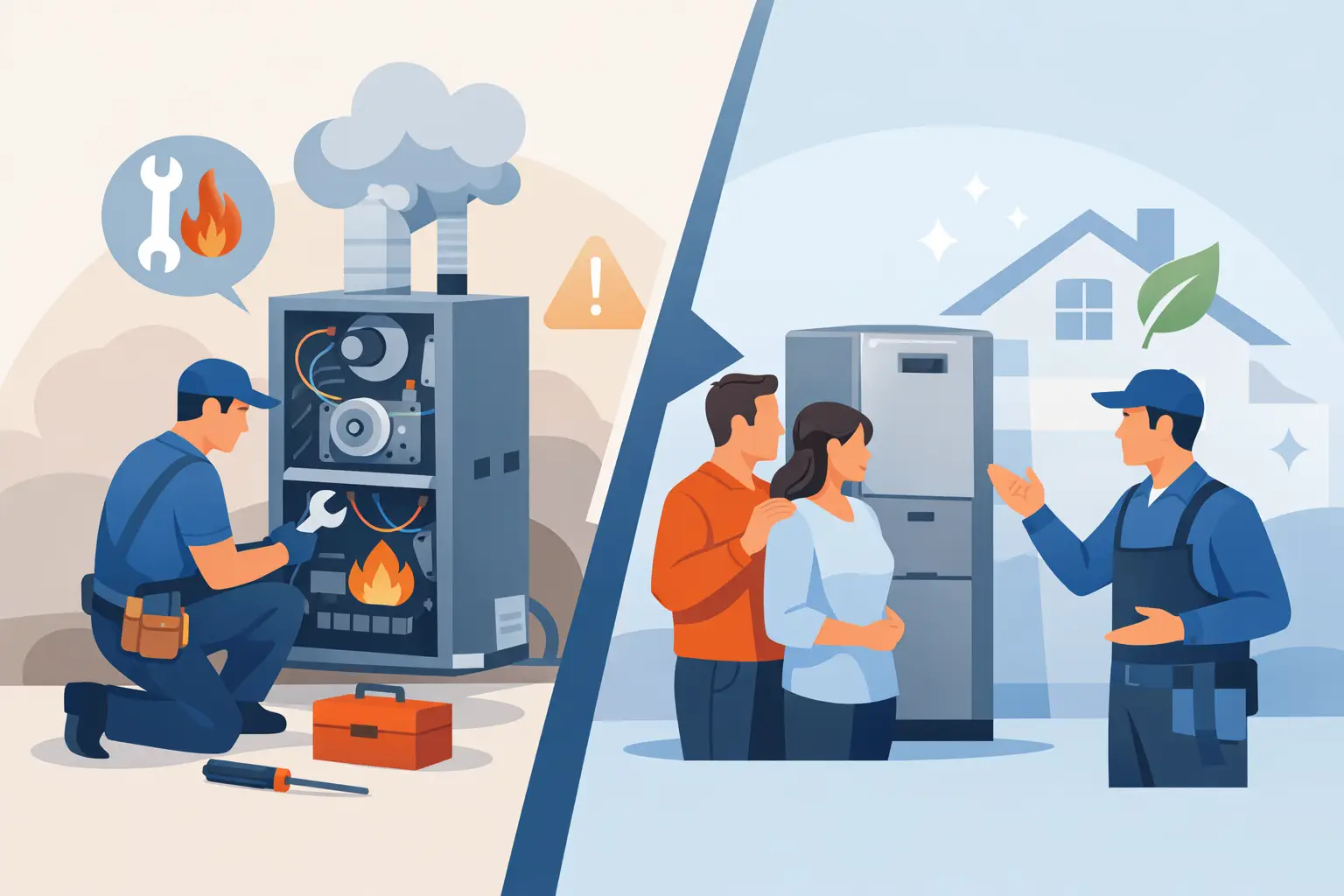
A furnace that quits on a cold San Antonio night creates an immediate question: should you fix it or replace it? Furnace repair vs replacement is not a decision that should be based on a sales pitch or a quick guess. The right answer depends on what failed, the condition of the rest of the system, your energy costs, and how long you need the equipment to serve your home or business.
A dependable HVAC professional should begin with accurate diagnostics, explain the findings in plain language, and provide clear pricing before recommending a path forward. Many furnace problems can be repaired safely and affordably. In other cases, putting more money into an aging or unreliable unit only delays a larger expense and leaves you with another disruption down the road.
Furnace Repair vs Replacement: What Should Drive the Decision?
The age of the furnace matters, but it is not the only factor. A well-maintained furnace may continue operating reliably beyond its expected service life, while a poorly maintained unit can develop significant issues much sooner. Most gas furnaces last roughly 15 to 20 years, though usage, installation quality, maintenance history, and local conditions all affect that timeline.
The type of repair is just as important as the furnace’s age. A failed ignitor, flame sensor, capacitor, thermostat issue, or minor electrical connection may be a straightforward repair, even on an older system. Replacing a furnace simply because one service call is needed is rarely the most economical choice.
The decision changes when the repair involves a major component, repeated breakdowns, unsafe combustion concerns, or a system that can no longer heat the property evenly. A trustworthy recommendation weighs the immediate repair against the likely cost and reliability of keeping the unit in service.
When Repair Is Usually the Better Choice
Repair is often the practical option when the furnace is under 10 years old, has received regular maintenance, and has not had a pattern of major failures. If the issue is isolated and the system is otherwise operating efficiently, a quality repair can restore dependable heat without the cost of a replacement.
For example, a furnace that runs but blows cool air may have an ignition, sensor, control board, or airflow issue. Those problems require proper testing, but they do not automatically mean the whole system has reached the end of its life. Likewise, a furnace that cycles on and off too frequently could have a thermostat setting problem, dirty filter, restricted airflow, or another repairable cause.
Property managers and business owners may also choose repair when a replacement is not practical during a busy season or when a unit still has useful life remaining. The key is knowing whether the repair is a reasonable investment, not simply the fastest way to get heat back on for one day.
When Replacement May Be the Smarter Investment
Replacement deserves serious consideration when a furnace is 15 years or older and needs an expensive repair. It may also be the better long-term choice when repair calls have become frequent, utility bills have risen without another clear explanation, or the system struggles to maintain a consistent temperature.
Safety concerns should never be treated as an inconvenience. A cracked heat exchanger, carbon monoxide issue, combustion problem, or major gas-related defect requires immediate professional attention. Depending on the diagnosis, repair may not be safe or cost-effective. A technician should explain the issue clearly and discuss appropriate options without using fear to pressure you into a purchase.
Replacement can also make sense when the existing furnace is oversized, undersized, or poorly matched to the ductwork and cooling equipment. An improperly sized system can short cycle, create uneven temperatures, and wear out components prematurely. Installing a new furnace without evaluating the full system can repeat the same comfort problems, which is why a professional assessment matters.
Consider the Real Cost, Not Just Today’s Invoice
A lower repair bill can be the right answer, but it should be viewed in context. If an older furnace needs a costly repair today and another component is likely to fail soon, the total cost of keeping it running may approach a meaningful portion of a new system’s cost. That is when replacement can provide better value.
A common rule of thumb is to consider replacement when a major repair costs close to half the price of a new furnace. It is only a guideline, not a hard rule. A 17-year-old furnace with a major repair need may justify replacement at a lower percentage because its remaining service life is limited. A newer, high-quality furnace with one unusual component failure may still be worth repairing even if the repair is not inexpensive.
Energy use belongs in the conversation as well. Older furnaces generally operate at lower efficiency than modern equipment. A higher-efficiency replacement can reduce fuel consumption, but the actual savings depend on your current unit, thermostat settings, insulation, duct condition, and how the property is used. An honest contractor will not promise a specific savings amount without understanding those details.
Warning Signs That Should Not Be Ignored
Some furnace problems call for prompt service whether you ultimately repair or replace the equipment. Strange smells, soot around the unit, a yellow burner flame instead of a steady blue flame, loud banging, repeated shutdowns, or a carbon monoxide alarm are not issues to wait on.
Turn the system off if you smell gas, leave the building if necessary, and contact the appropriate emergency service provider. Do not try to diagnose gas or combustion problems yourself. Once the immediate safety concern is addressed, a qualified HVAC technician can inspect the furnace and explain the condition of the equipment.
Less urgent signs still deserve attention before they become a no-heat call. Rooms that never warm up, unusually high gas bills, frequent filter buildup, short cycling, or a furnace that takes longer than usual to start can point to airflow, controls, ductwork, or equipment issues. Early diagnostics often give you more choices and more time to plan.
A Replacement Should Solve More Than One Problem
If replacement is the right path, the goal should not be to install the first available furnace with the same nameplate size. Proper replacement begins with evaluating the property, heating load, existing ductwork, ventilation, thermostat controls, and the relationship between the furnace and air conditioning system.
For homes, this helps prevent hot and cold rooms, excessive noise, humidity concerns, and unnecessary energy use. For commercial properties, it helps protect tenant comfort, operating hours, and budget predictability. A replacement recommendation should include equipment options that fit your needs and explain the differences in efficiency, warranty coverage, expected performance, and installed cost.
Transparent pricing matters here. You should know what work is included, whether duct or electrical modifications are needed, and what steps will be taken to ensure safe operation. The lowest initial quote is not always the lowest-cost decision if it leaves important installation details unresolved.
Maintenance Can Change the Equation
Regular maintenance cannot prevent every furnace failure, but it can catch developing issues before they cause a breakdown. During a professional heating tune-up, a technician can inspect safety controls, test ignition and combustion components, check electrical connections, evaluate airflow, and identify wear that may affect reliability.
Changing filters on schedule also helps protect the furnace. A clogged filter restricts airflow, makes the equipment work harder, and can contribute to overheating or premature component failure. Keep return vents clear, pay attention to new noises or comfort changes, and schedule service before the first sustained cold spell when possible.
For an aging furnace, maintenance provides valuable planning information. You may learn that the system is in good condition and worth keeping, or you may get early notice that replacement should be budgeted for before an emergency forces the decision.
Get an Honest Diagnosis Before You Decide
No two furnaces, properties, or budgets are exactly alike. The best decision comes from a clear diagnosis and a realistic discussion of repair cost, system condition, safety, efficiency, and your long-term plans for the property. You should never feel rushed into replacing equipment that can be repaired properly, and you should not be encouraged to keep investing in a furnace that is becoming unsafe or unreliable.
Cadillac Air Conditioning & Heating provides straightforward assessments for San Antonio-area homeowners and businesses, with recommendations built around what makes sense for your comfort and budget. If your furnace is making unusual noises, failing to heat consistently, or has stopped working altogether, scheduling a professional inspection can give you the clarity to make the next decision with confidence.
